


180. Watch Out for Half-Truths | 小心那些半真半假的訊息
Musings of Dr. Jamie C. Hsu, 1.20.2026
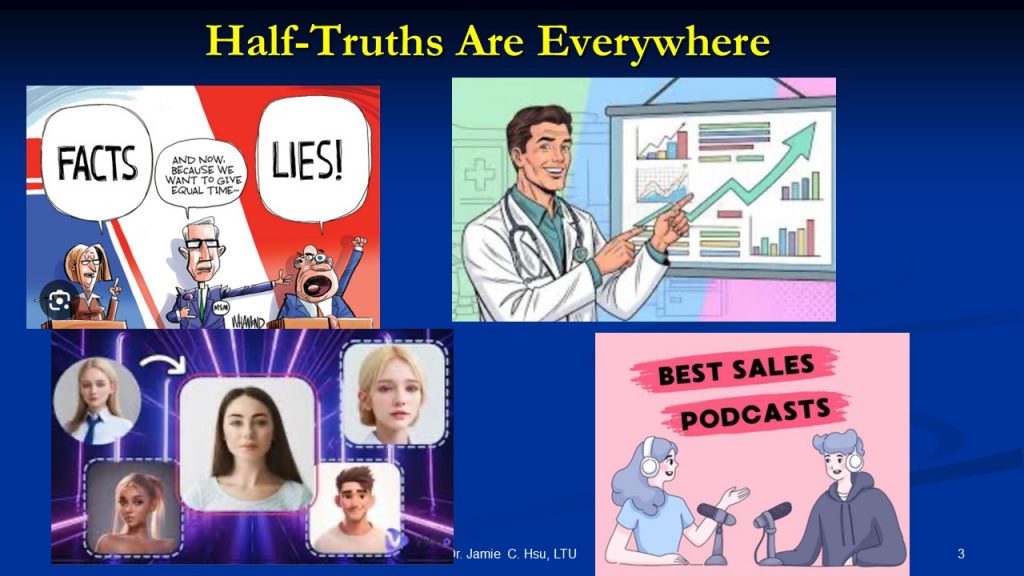
In these days of internet communication, digital media, and AI-generated images, we are bombarded with half-truths, which may appear to be authentic and innocent until we find out the real hidden agenda behind these messages. In the information overflow era, simplicity and novelty often trump nuance and accuracy. Here are a few examples of half-truths commonly seen in the news and the real reasons for the falsehoods.
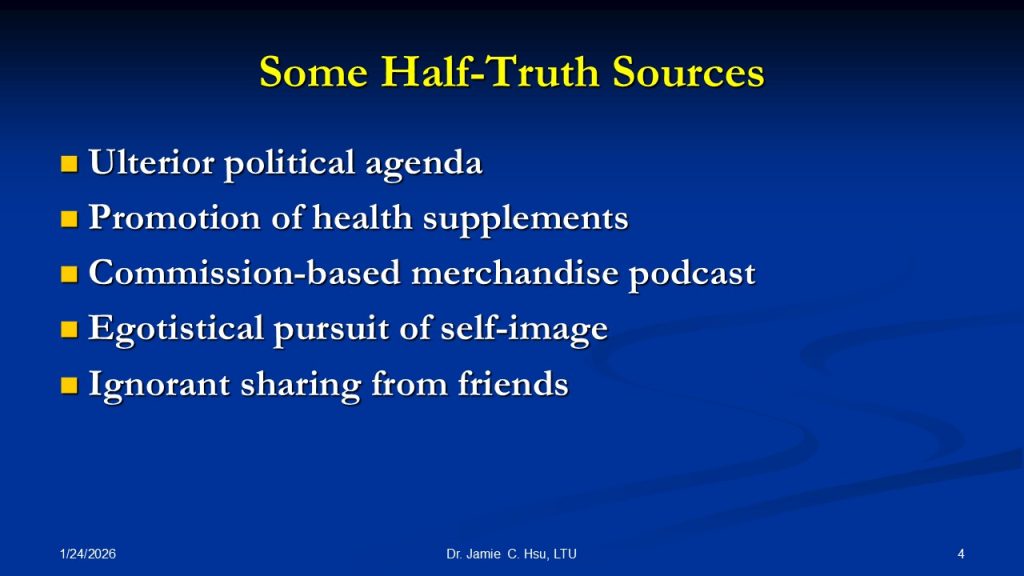
Ulterior political agenda: In order to gain political advantages in elections and to recruit supporters, politicians may quote phrases and describe the behavior of their opponents out of context. A simple phrase like “I don’t know,” taken out of context, may be cited as incompetence or a lack of caring. They may declare national security and global peace as the pretext, while the real reason might be to satisfy personal ego or achieve power grabs. There was a sad, real example of using half-truth in recent news. In order to change the national health guidelines, the US president claims that exercise might deplete our body’s energy like using a battery.
Promotion of health supplements: In many media reports and podcasts on health and disease prevention, a self-claimed former doctor or nutritionist will describe the pain and symptoms caused by a particular disease to get your agreement and gain your trust. Then they jump to the solution of a supplement or topical treatment, without providing much clinical evidence or scientific explanation. The half-truth has increased their sales and income.
Commission-based merchandise live streamers: Nowadays, live streaming is a low-cost way of making a living for many entrepreneurs. They enthusiastically endorse merchandise, citing personal experience or testimonies of other users. Their findings may not be comparative or statistically based, but their commission depends strongly on whether they can convince you that you are hearing the whole truth.
Egotistical pursuit of self-image: Many people alter their photos or use AI software to beautify their faces and create elegant movements of their bodies. This type of ego-boosting behavior is increasingly common for people of all ages.
Ignorant sharing from friends: It is most difficult to correct our friends who innocently pass along disinformation with good intentions.
The half-truths may never end. We just need to be aware of them and manage them judiciously.
小心那些半真半假的訊息 (2026/01/20)
-作者 許俊宸博士
-中譯 薛乃綺
當今這個充滿網路溝通、數位媒體與 AI 生成影像的時代,我們每天都被各式各樣的「半真半假」訊息包圍。這些內容乍看之下真實又無害,往往要等我們發現背後隱藏的動機,才驚覺事情並不單純。在資訊爆炸的年代,簡單、吸睛的新鮮感,常常比細膩與正確性更容易勝出。以下是新聞中常見的幾種半真半假的例子,以及它們為何會出現的原因。
政治上的私心算計:
為了在選舉中取得優勢、拉攏支持者,政治人物有時會斷章取義,引用對手的話或行為。一句像是「我不知道」,在脫離原本脈絡後,就可能被解讀成無能或冷漠。他們也可能打著「國家安全」或「世界和平」的旗號,實際上卻是在滿足個人自尊或爭奪權力。近期就有一個令人感慨的真實案例:為了改變國家健康指引,美國總統曾宣稱運動會像用電池一樣耗盡人體能量。
健康補充品的行銷話術:
在不少健康與疾病預防的媒體報導或 Podcast 中,自稱是前醫師或營養師的人,會先描述某種疾病帶來的痛苦與症狀,讓你點頭認同、建立信任,接著就直接推薦某種保健品或外用產品,卻很少提供充分的臨床證據或科學說明。這樣的半真半假,往往替他們帶來可觀的銷量與收入。
抽佣制的直播帶貨:
現在,直播成了許多創業者低成本謀生的方式。直播主熱情推薦商品,引用自己的使用經驗或其他人的見證。這些說法未必有比較基礎或統計數據,但他們的收入,往往取決於能否讓你相信「這就是真相的全部」。
對自我形象的過度追求:
許多人會修圖,或使用 AI 軟體美化面容、讓體態動作看起來更優雅。這種為了滿足自我形象的行為,變得越來越普遍,而且不分年齡。
朋友的善意錯誤轉傳:
最難處理的,往往是朋友出於好意、卻在不知情的情況下幫著轉傳錯誤訊息。要糾正這類「無心之過」,並不容易。
半真半假的訊息,可能永遠不會消失。我們能做的,就是保持警覺,用更理性、謹慎的態度去看待與處理它們。
